Counsellor Onboarding Training
I wrote the manual. Then I had to admit most of it was not training.
Don't take my word for it. The full program runs right here: four weeks, eight modules, and the assessments in between.
A manual a new counsellor reads once and never opens again.
A new counsellor at a study abroad agency is on the phone with a real family in their first week. What they need in that moment is a way to read the lead, hold a price objection, and know which promises they are allowed to make. What the manual gave them was 84 pages, most of it catalog.
I wrote that manual. Rebuilding it meant auditing my own work and finding that only three sections carried real training value: sales, business rules, and lead qualification. The rest was reference material wearing a course's clothing.
Six decisions, and what each one cost.
Every one of these made the program smaller. That was the point.
Roughly 60% became job aids
Catalog and link content does not need a learner to sit through it. It needs to be findable at the moment of use. Six job aids absorbed that material, and the course stopped pretending to teach it.
Six weeks compressed to four
No agency withholds students from a new counsellor for six weeks. A ramp nobody can afford to run is not a ramp. Four weeks: mandate and reading the lead, first session and matching, objections and pipeline, then in-country and the capstone.
Proof comes from structure, not seat time
Every deliverable ties to something a verifier witnessed or can check against a system. Time in the course proves nothing on its own, and an assignment that a language model can complete alone proves less than nothing.
A dual track, because not every new hire has a case
If the learner has their own live case, they use it. If they do not, a manager assigns one or they shadow a call. The evidence requirement never softens.
Two AI roleplay coaches, not a chatbot
A first session with an anxious first-time caller, and a returning prospect whose polished objections sit in front of a worry he will not volunteer. The learner practices the conversation before they have it with a real family.
Three observed calls survived the cut
Everything else was compressible. Observation was not. A manager watching the actual call is the only check that reaches the behavior the program is aiming at.
Then I edited it like a stranger wrote it.
A finished course can still read like a machine drafted it. Before showing this one to anyone, I ran every screen through two standards: one for the words, one for the pictures.
The words: one voice, no tells
I screened all nine lessons for the habits that mark machine-assisted writing: ninety-two em dashes cut to zero, repeated sentence rhythms broken up, every module's last line rewritten so it lands instead of posing. The course now reads the way a senior counsellor talks.
The pictures: one amber rule
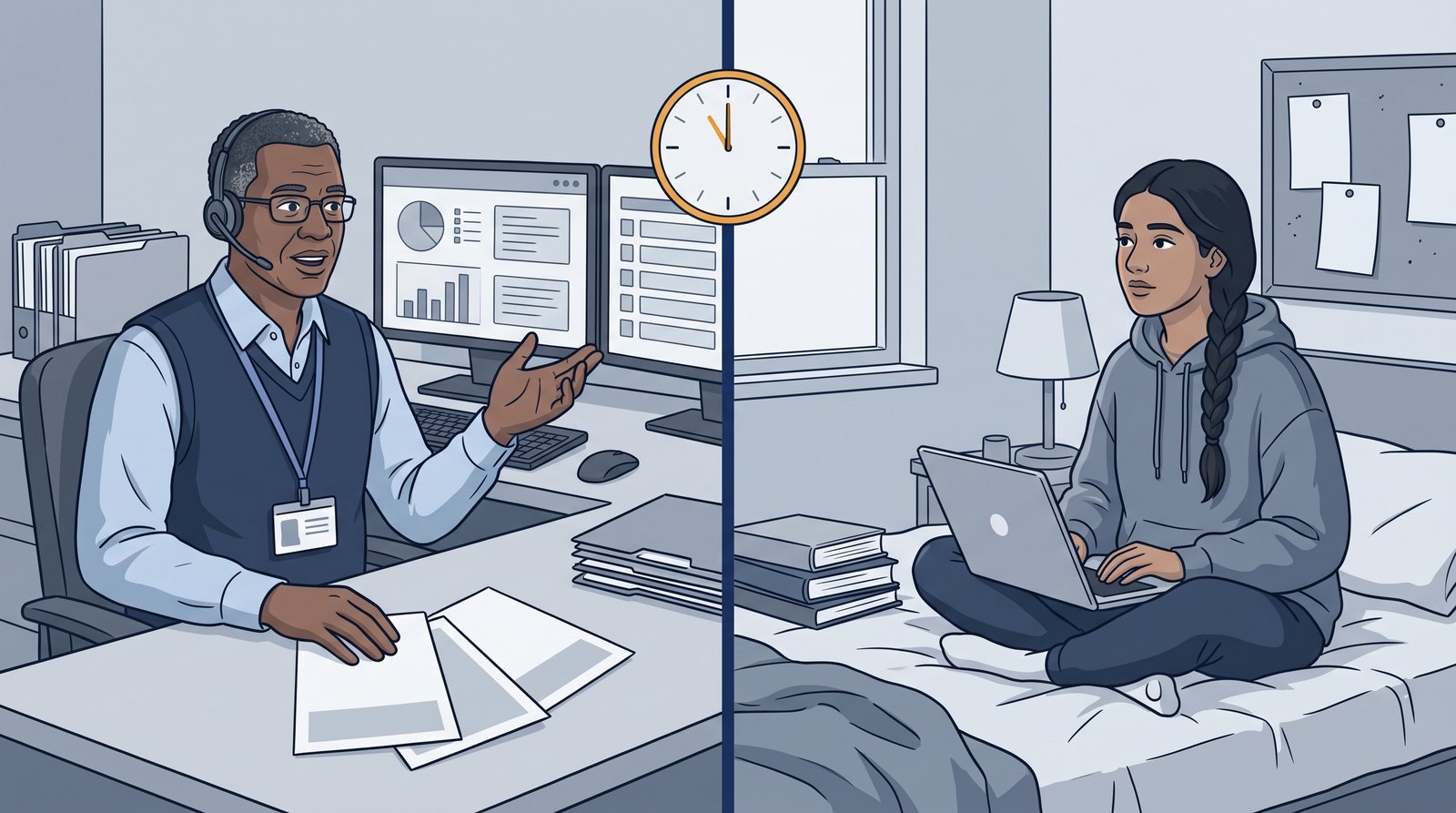
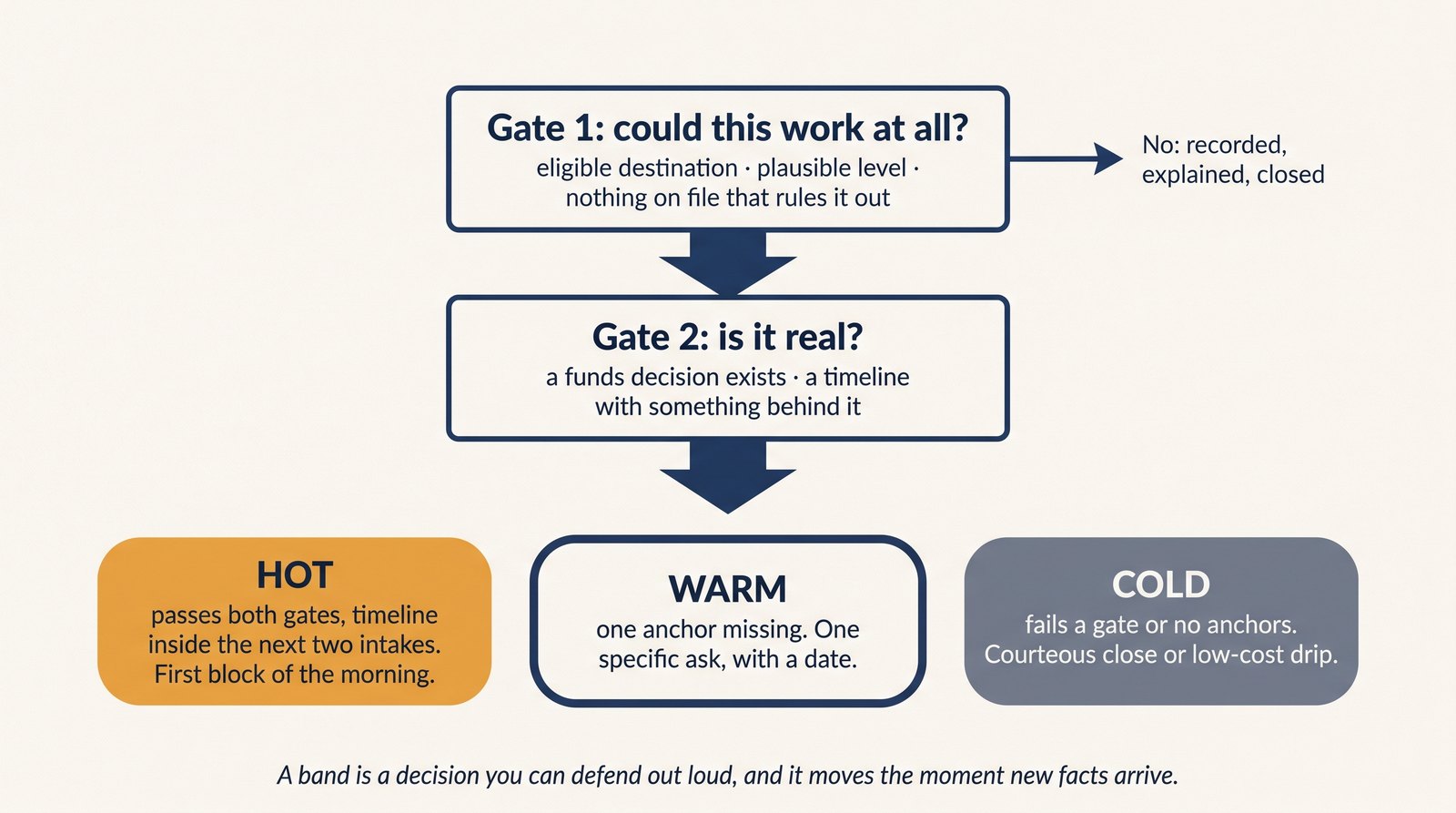
Stock photos came out. In went six illustrated scenes and three diagrams on a single palette, with one rule: each image carries exactly one amber element, placed on the thing the scene is about. The cast was designed on a sheet before generation, so counsellors and students read at a glance and no one group carries the whole course.
Built and shippable. Unproven.
- — Design and authoring are complete. Eight modules, six job aids, two AI roleplay coaches, and the full assessment pack are written. The program carries both numbers it should be judged on: a four-week ramp, around six hours of seat time.
- — What I have is a finished program, not a proven one. The build is done and you can walk through it. What I cannot show you is a completion rate, a ramp time, or a manager saying it worked, because nobody has been through it yet.
- — The company is fictional, the institutions are not. Anonymizing the employer protects a real business. Anonymizing the universities would have made the business rules meaningless, so those stayed real.
- — Cutting my own writing was the hard part. Removing 60% of a document I authored required admitting that most of the work I was proud of belonged in a reference file, not a course.
See how the rest of the work gets made.
The same system that drafted, checked, and documented this program also runs the other projects on this site.
Let's talk.
Hiring, a project, or a question about how something on this site was built. It reaches me directly and I answer every one.