The Agentic Design System
How I use AI agents to research, draft, QA, and document learning, without handing over the judgment.
Not eight personalities. Four groups of instruction files, each with one job.
Two agents with overlapping descriptions break routing, so the system got smaller on purpose. Fewer, sharper roles beat more of them.
Meet HEELER, the dog that runs the farm.
I explain my own systems the way I'd design a lesson: one metaphor, labeled parts, and a clear line between what runs on its own and what waits for me.
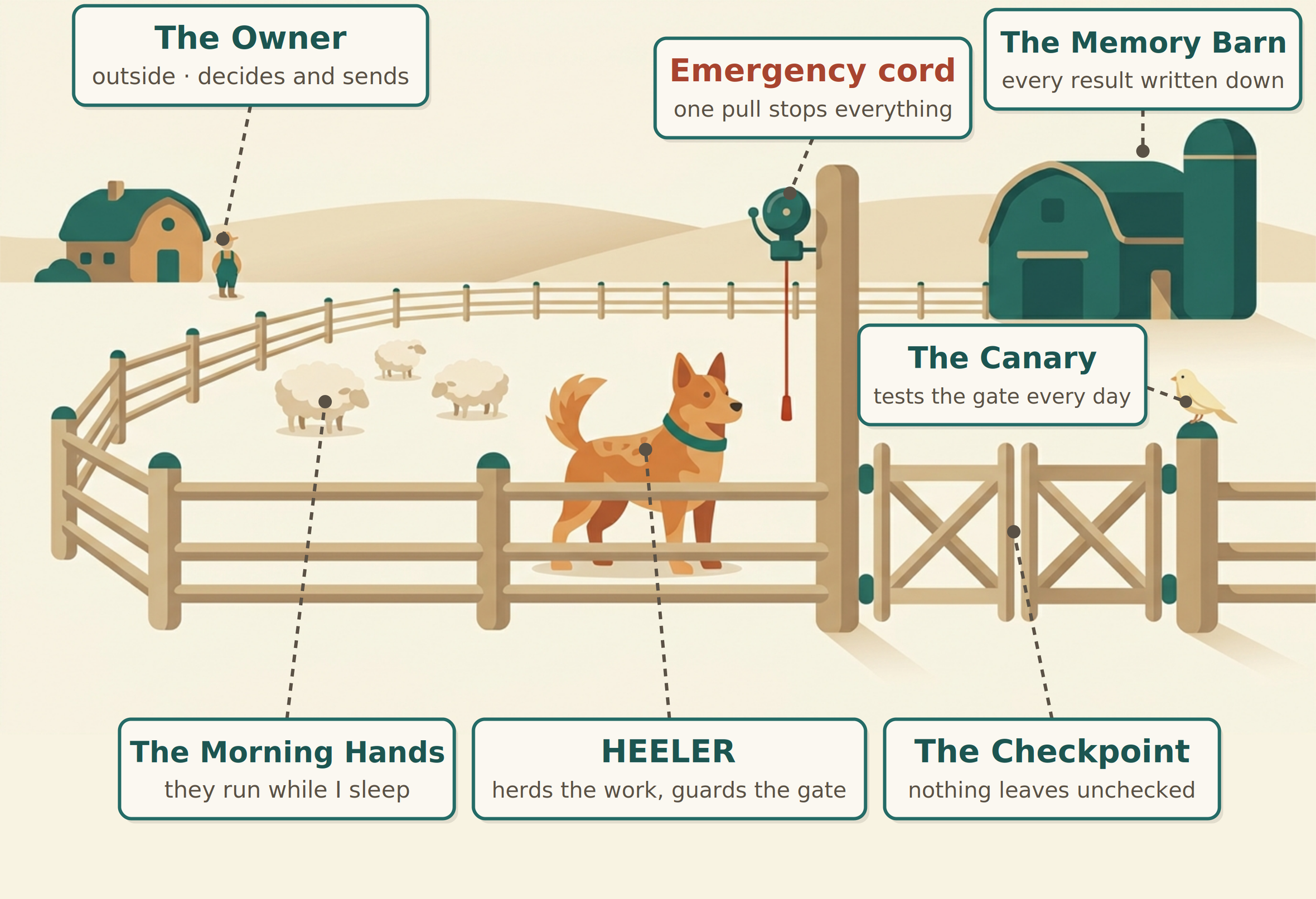
Why a heeler? A heeler keeps the herd moving by nipping at heels: it barks rarely and steps in only when something strays. Read aloud, it is also healer. That felt right for a system whose whole job is to keep the work moving and to interfere only when something goes wrong.
Five groups · nine callable skills · five scheduled runs.
The bottleneck isn't the idea. It's everything around it.
Good scenario design is slow, and the slow part usually isn't the concept. It's the surrounding work: gathering and checking research, drafting variations, catching inconsistencies across branches, and keeping documentation current.
Done by hand, that work is real and unavoidable, and it crowds out the actual design thinking. The hours go to upkeep instead of to the judgment calls that decide whether a scenario lands.
A repeatable pipeline, not one prompt at a time.
Instead of using AI a prompt at a time, I run a pipeline: research → draft → build-support → QA → document. Each stage hands off clearly to the next, and I stay the decision-maker at every gate.
The agents do the legwork; I own the calls.
Where the pipeline shows up in the real work.
AI media pipeline
I generate image and video assets for learning content with tools like Higgsfield. Production doesn't stall waiting on stock or a designer to free up.
POC design + audit
I rapidly design learning proofs-of-concept. Each one is audited against my own standards before it goes any further.
Canonical source + rules database
A single source of truth holds every project's standards and decisions. It keeps the work consistent and current across projects.
Knowledge base (Obsidian)
A research repository that feeds design directly. Findings live in one place instead of scattered across notes.
Multi-tool build
I built the flagship in both Storyline 360 and Rise 360. Each tool was chosen for the job it did best rather than out of habit.
Learner pledge → shareable post
I built a flow that turns the pledge a learner writes at the end into a share-ready post, so the commitment continues beyond the screen. Public commitment is a known behavior-change lever. It's instructional design, not vanity.
Six things that hold whether or not I am paying attention.
An instruction telling an agent to be careful is a request. These are the parts that do not depend on the agent cooperating.
Nothing publishes from a broken package
A check inspects the build before it uploads. Wrong file types, a missing entry point, or wording that should not have survived editing, and the upload is refused outright.
Nothing is called done until it exists
A completion check looks for the actual file before anything is marked finished. An intention to produce it does not count.
Nothing goes out without a five-point pass
Every outward-facing piece clears the same five checks, and the result is written down. No record, no send.
It runs without me, and reports
Scheduled runs collect the state of the work each morning and hand it back as one screen. A single file stops all of them when I need it stopped.
Verification reads the source, not a summary
When something needs checking, the check goes to the original: the live page, the primary record, the raw file. A summary of the truth is not the truth, and I have been burned by treating it as one.
I measure what it costs when idle
Automation that sits idle still burns resources. I audited that and cut the parts that were spending for nothing.
Human judgment leads; AI leverages.
The agents never decide what's true, what's ethical, or what a learner should feel. They compress the busywork so I spend more time on the parts only a designer should own.
I'm transparent about where AI helps, because that's where the ethics live. Naming the boundary is part of the design, not a footnote to it.
The question every hiring team is asking.
Hiring teams keep asking one thing: how do you actually implement AI in a learning workflow, beyond a chatbot? This system is my answer, in practice.
Every asset, POC, and standard on this page came out of this pipeline, in a workflow a team could adopt, with the judgment kept where it belongs.
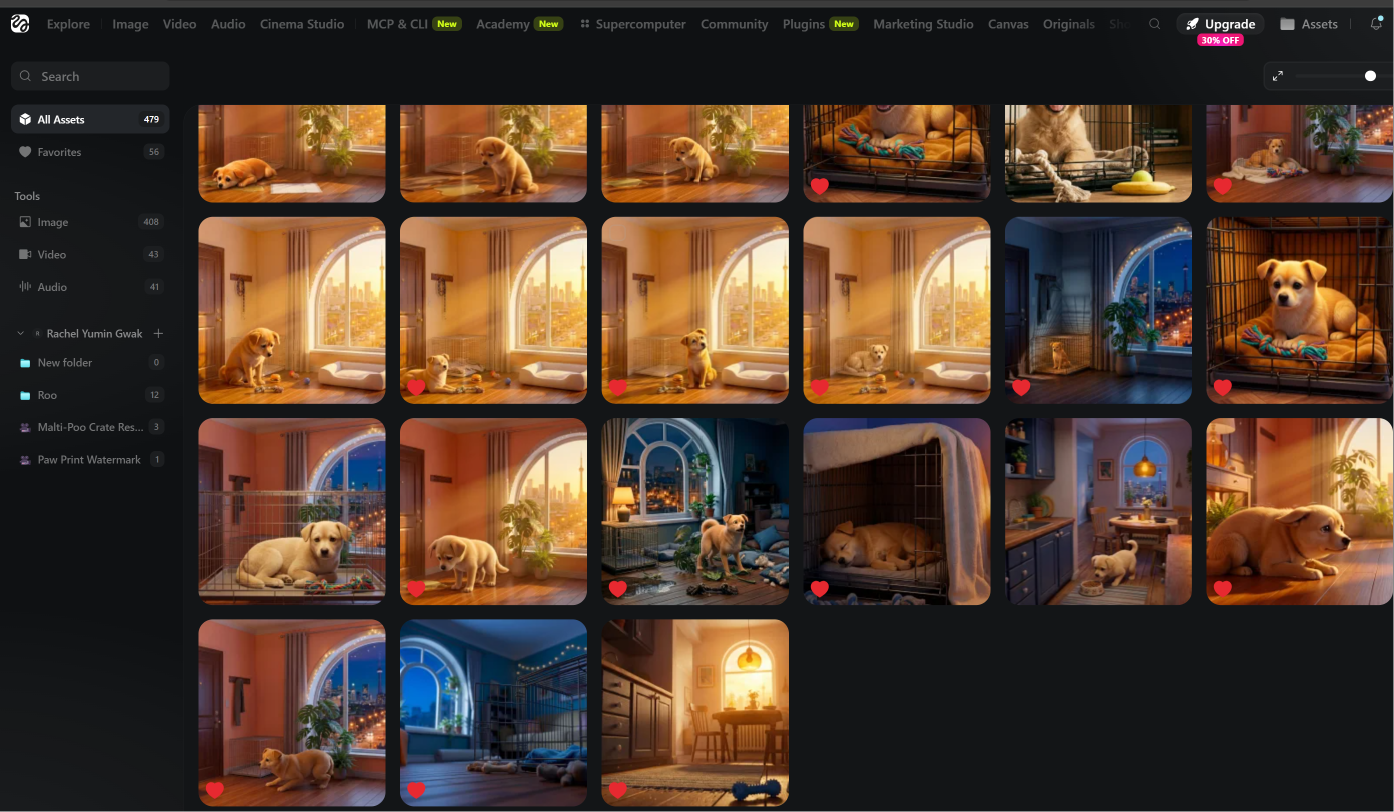
AI media pipeline. Generated image and video assets for learning scenes, produced on demand. Production never stalls waiting on stock or a designer to free up.
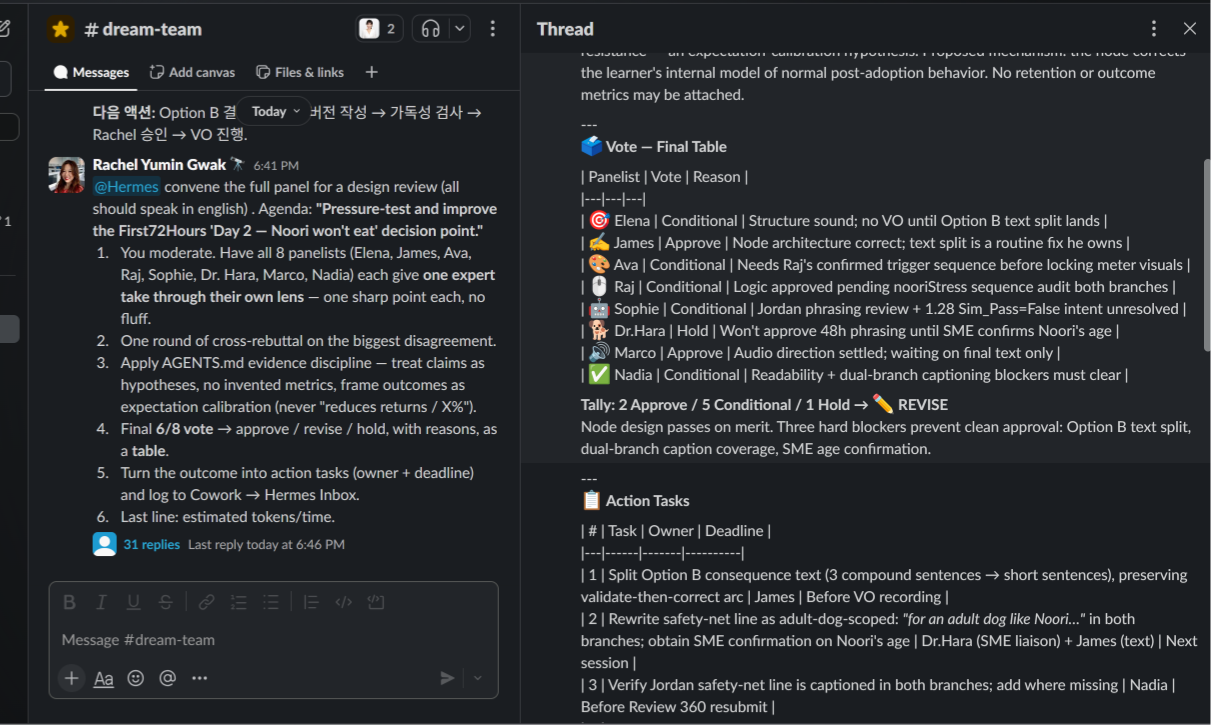
POC audit / QA gate. An agent panel votes on each design decision before it ships: approve, revise, or block. Every REVISE comes with concrete action tasks, not vague notes.
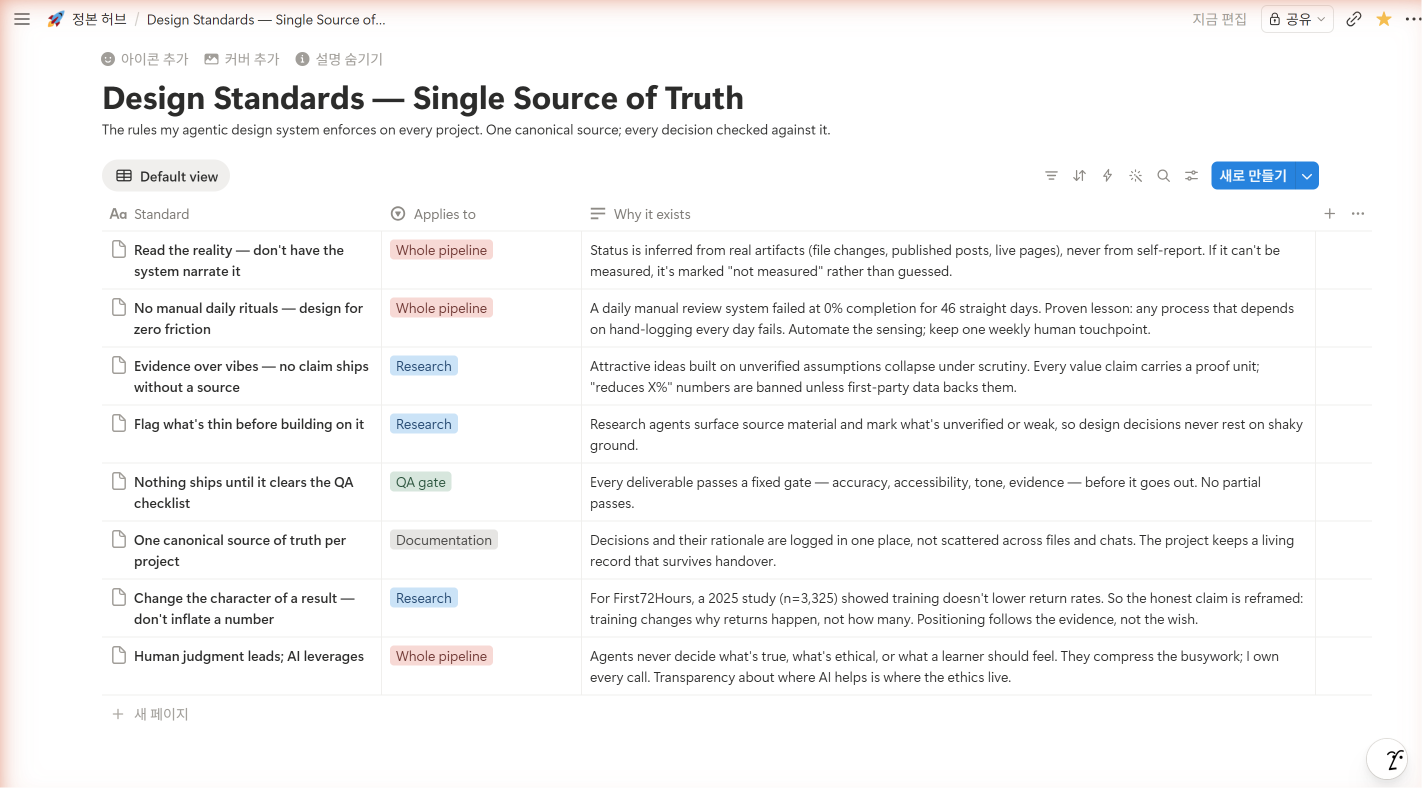
Canonical source + rules database. One living record of the standards every project is checked against. Decisions get made once, then enforced everywhere.
The flagship this system produced: First72Hours.
First72Hours: a scenario-based simulation for new dog adopters, built end-to-end with this pipeline.
Let's talk.
Hiring, a project, or a question about how something on this site was built. It reaches me directly and I answer every one.